Why the Same Penha Drain Keeps Blocking, and the Real Fix
If you own a building in Penha, you already know the pattern: the same drain backs up, often in the same month, followed by the same emergency call. The technician clears it, the water flows, and everyone relaxes — until the next time. The question worth asking is not who can unblock it again, but why it keeps happening at all. A reliable desentupidora Ponte Rasa team treats recurring blockages as a symptom to diagnose, not just a pipe to clear.
Most repeat blockages are not bad luck. They come from a specific cause that was never addressed: a shallow slope, a root intrusion, a buildup of grease and scale, or a drain that was never sized for what the building actually sends through it. Once you identify the cause, the permanent remedy becomes obvious. This article walks through the causes residents and owners in Penha see most often, and what a lasting fix looks like for each one.
The Pattern: Same Drain, Same Month, Same Emergency Call
Recurring blockages usually follow a rhythm. A kitchen drain that clogs every few months is telling you that grease and food waste are accumulating faster than the pipe can carry them. A floor drain that backs up during heavy rain is telling you something about the stormwater connection or the slope of the line. A toilet that gurgles and drains slowly is often warning of a partial obstruction further down the main stack.
The mistake most buildings make is treating each event as isolated. A plunger, a hand snake, or a quick chemical treatment restores flow for a while, but it does not remove the underlying condition. Recurring blockages are a diagnosis problem, not a clearing problem. The right response is to document when and where the backup happens, then investigate the line itself.
For buildings in Penha and the surrounding east zone, a professional desentupidora Ponte Rasa São Paulo SP service can inspect the line with a camera and map the actual cause before recommending a fix. That inspection is what separates a temporary clearing from a repair that holds.
Cause 1: Grease, Scale and Sediment Buildup
The most common cause of repeat kitchen and laundry blockages is accumulation. Cooking fats cool and stick to the pipe wall, then soap scum, food particles and mineral scale bind to that layer. Over time the pipe narrows, and flow slows until a small obstruction is enough to stop it completely. Snaking punches a hole through the blockage, but the coating remains, so the problem returns.
Why chemical drain cleaners make it worse
Caustic and acidic cleaners can damage older pipes, especially PVC joints and cast iron, and they rarely remove the full layer of buildup. They also create a false sense of security because the drain flows again for a few weeks. In a building with shared stacks, the dissolved grease simply re-solidifies further downstream, moving the blockage rather than removing it.
The permanent remedy: hydrojetting and a maintenance schedule
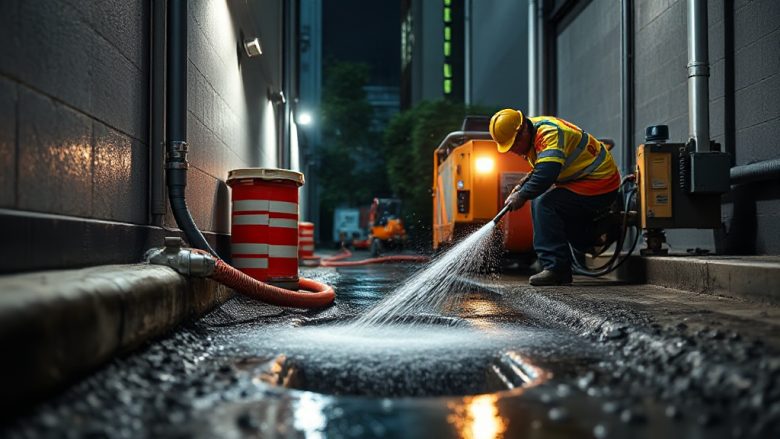
High-pressure hydrojetting scours the full interior of the pipe, removing grease, scale and sediment back to the bare wall. For kitchens and laundry lines in Penha buildings, this is usually the only way to reset the line. Pairing it with a scheduled cleaning — every six to twelve months depending on volume — prevents the layer from rebuilding to the point of blockage. Grease traps and strainers at fixtures also reduce what reaches the pipe in the first place.
Cause 2: Root Intrusion and Structural Damage
Tree roots are drawn to the moisture and nutrients inside sewer lines. A hairline crack or a loose joint is enough for a root to enter, and once inside, roots grow into a dense mat that catches paper, wipes and debris. Clearing the line cuts the roots back, but the root system regrows toward the same opening, which is why the blockage returns season after season.
How to confirm roots are the cause
A camera inspection shows roots entering at a specific joint or crack. Without that inspection, a building owner may keep paying for clearing while the actual defect — a damaged pipe or open joint — stays in place. Signs include repeat blockages in the same section, slow drainage across multiple fixtures, and gurgling sounds after rain.
The permanent remedy: repair the entry point
The lasting fix is to repair or replace the damaged section of pipe and seal the joint. In some cases, a cured-in-place liner can restore the pipe interior without excavation. Root control treatments can slow regrowth, but they are a supplement, not a substitute for repairing the defect. Once the entry point is closed, the line stops collecting roots.
Cause 3: Poor Slope, Bellies and Incorrect Connections
Gravity is the only force moving waste through most building drains. If a section of pipe has settled — creating a low spot or “belly” — water pools there, solids settle out, and the line blocks repeatedly at the same point. The same happens when a drain was connected with too little slope, or when a fixture was tied into a line that was never designed to carry it.
Why clearing alone never fixes a belly
A snake or jetter can push through a belly, but the low spot remains. Every time the line runs, solids settle again. Buildings that have had the same drain cleared three or four times in a year are often dealing with a slope or settlement problem rather than a simple clog.
The permanent remedy: correct the grade
Fixing a belly means excavating and re-laying the affected section at the correct fall, or relining it where that is technically suitable. It is more work than a clearing, but it is the only fix that stops the cycle. A camera survey and a level check confirm the problem before any excavation begins, so the repair is targeted rather than speculative.
Cause 4: Undersized Pipes and Overloaded Systems
Older buildings in Penha were often plumbed for fewer fixtures and lower occupancy than they now serve. When a residence becomes a restaurant, a shop adds a washroom, or a building adds units without upgrading the drainage, the pipe carries more than it was sized for. The result is chronic slow drainage and repeated blockages at the same stack.
Signs the system is overloaded
Multiple fixtures backing up at once, water rising in floor drains when appliances run, and blockages that appear whenever the building is busiest all point to capacity, not a single clog. In these cases, clearing the line brings only brief relief.
The permanent remedy: upgrade or separate the lines
The durable solution is to upsize the affected section, separate greywater from sewage where possible, or add a dedicated line for high-volume fixtures. A professional assessment of the building’s actual load — not its original design — determines what is needed. This is where a desentupidora em Ponte Rasa São Paulo SP team with experience in both residential and commercial buildings adds real value: the fix has to match how the building is used today.
What a Permanent Fix Actually Looks Like
A permanent fix follows a sequence rather than a single visit. First, the cause is identified with a camera inspection and a review of the building’s drainage layout. Second, the line is cleaned properly — usually by hydrojetting — so the pipe interior is visible. Third, the defect is repaired: the root entry point sealed, the belly re-graded, the undersized section upgraded, or the damaged pipe relined. Fourth, a maintenance schedule keeps the line from returning to its old condition.
Building owners should expect a written report of what was found, photos or video of the line before and after, and a clear explanation of why the recommended repair addresses the cause rather than the symptom. A team that only offers to clear the drain again has not diagnosed anything.
Preventive maintenance is the cheapest part of the whole process. Scheduled hydrojetting, strainers at sinks and floor drains, grease traps in commercial kitchens, and prompt repair of small leaks all extend the life of the system and prevent the emergency call that always seems to arrive at the worst possible time. For buildings that have already had the same drain cleared repeatedly, the investment in diagnosis and repair pays back within a few blocked seasons.
Frequently Asked Questions
Why does my drain keep blocking even after it is cleared?
Because clearing removes the obstruction but not the cause. Grease scale, root intrusion, a settled pipe or an undersized line will all cause the blockage to return. A camera inspection identifies which one applies to your building.
Is hydrojetting safe for older pipes?
When pressure is adjusted to the pipe material and condition, hydrojetting is safe and is usually the most effective way to remove buildup. A pre-inspection confirms whether the pipe can withstand the pressure or needs repair first.
How often should a building have its drains maintained?
It depends on use. A residential building may need annual cleaning of kitchen and laundry lines, while a restaurant or busy commercial kitchen may need it every few months. A maintenance schedule should be based on the building’s actual load, not a generic interval.
Can tree roots be removed without digging up the pipe?
Roots can be cut and cleared without excavation, but they regrow unless the entry point is repaired. Relining or spot repair of the damaged joint is the durable solution.