You’re standing at the edge of a park pond, hands in your pockets, trying to look casual. A duck paddles past. Somewhere behind you a squirrel is losing its mind over an acorn. And a small voice in your head asks: am I actually doing this right? Should I have binoculars? Am I standing too close? Is it weird to be this still?
Good news. Wildlife watching questions answered simply is exactly what this article does. No jargon, no gatekeeping, no lecture about Latin names. Just plain answers to the things beginners actually wonder about, written by someone who has spent a lot of quiet hours watching animals do ordinary, extraordinary things.
Wildlife watching is a skill anyone can learn. It rewards patience over equipment and curiosity over expertise. If you can stand still for ten minutes and pay attention, you already have the two most important tools.
Do I need special gear to start wildlife watching?
No. This is the question people ask most, usually while eyeing a pair of binoculars online that cost more than their rent.
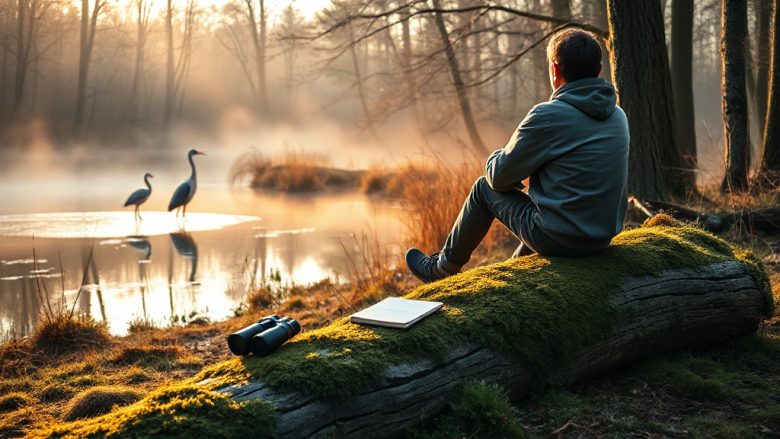
You need three things, and two of them are free: patience, quiet, and something to sit on if you plan to stay a while. A folded jacket works fine. Binoculars help, but they’re not a requirement. If you do buy a pair, cheap 8×42 binoculars will show you more than you expect. The number before the x is magnification; the number after is lens size. Eight times magnification is the sweet spot for beginners because it’s steady in the hand and wide enough to find what you’re looking for.
A phone camera is fine for record shots, but don’t let it become the point. Some of the best wildlife watching happens when your hands are empty and your attention is full. If you want to identify what you’ve seen later, a small notebook and a pencil beat a photo every time, because writing down what you noticed forces you to actually notice it.
Where should I go to see wildlife?
Start where you already are. Your garden, a local park, a canal towpath, the scrubby edge of a housing estate. Wildlife doesn’t require a nature reserve. It requires habitat, and habitat exists in more places than people think.
Look for edges. The boundary between two kinds of landscape, where a hedge meets a field or a lawn meets a pond, is where the most activity happens. Animals use edges as highways, hunting grounds and hiding places. A single mature tree in a car park can hold more life than a tidy lawn ten times its size.
If you want to travel somewhere, choose a place with water. Ponds, streams, lakes and even puddles concentrate wildlife because everything needs to drink. Early morning is the best time. Not because it’s a rule, but because most animals are feeding then and the world is quieter. Dusk works too, especially for bats and foxes.
How close can I get without disturbing animals?
Closer than you think, if you let them come to you. Further than you want, if you chase.
The honest answer is that distance depends on the animal. A robin will hop within arm’s reach while you’re digging soil. A deer will bolt if you so much as shift your weight at fifty metres. The rule that works for almost everything is this: if the animal changes what it’s doing because of you, you’re too close.
Watch for the signs. A bird that stops singing. A squirrel that freezes mid-chew. A deer that lifts its head and stares. These are not invitations to creep forward. They’re the animal deciding whether you’re a threat. Back off slowly, or better still, stop moving entirely and let it settle. Half the skill of wildlife watching is learning to be boring.
Never feed wildlife to get closer. It changes their behaviour, makes them depend on people, and can make them aggressive. A fed fox is a dead fox, sooner or later. Enjoy them at their distance, not yours.
What time of day is best for wildlife watching?
Dawn and dusk. This is the old advice and it’s true for good reasons. Many animals are crepuscular, meaning they’re most active in the low light at either end of the day. Birds sing hardest at first light. Mammals move under cover of twilight. Insects swarm at dusk in summer.
But don’t treat it as a law. Overcast days push activity into the middle of the day. Winter changes everything, because animals need to feed whenever they can get warmth. And some of the best sightings happen at completely ordinary times, like a sparrowhawk crashing through a suburban garden at two in the afternoon while you’re hanging out washing.
If you only have one free hour a week, use it. Consistency beats timing. The person who visits the same patch every Saturday morning will see more than the person who chases perfect conditions once a month.
How do I identify what I’ve seen?
Start with shape and behaviour, not colour. Colour changes with light, age and season. A bird that looks brown in shadow can be yellow in sun. But the way it moves, feeds and holds itself is reliable.
Ask simple questions. Is it bigger or smaller than a blackbird? Does it hop or walk? Does it perch upright or cling sideways? Does it feed on the ground, in the branches, or in the air? Write the answers down. Then, later, use a field guide or an app to narrow it down. You don’t need to name everything. Naming is a bonus, not the goal.
Get to know ten common species really well. In most of the UK, that means things like robins, blue tits, wood pigeons, grey squirrels, mallards and maybe a fox. Once you know those deeply, everything else stands out as different, and identification gets much easier. It’s like learning faces in a new town. The regulars become obvious, and the strangers become interesting.
Is it okay to watch wildlife alone, and is it safe?
Yes, and mostly yes, with common sense. Wildlife watching alone is one of the quiet pleasures of life. No one to hurry you, no one to talk over the moment. But a few practical habits make it safer and better.
Tell someone where you’re going and when you expect to be back. Take a charged phone, water and a waterproof layer, because weather turns. Stay on paths in unfamiliar places, especially near water and cliffs. If you’re watching in an urban area at dusk, stick to well-lit, public routes.
And respect the law, which is mostly about not disturbing protected species. In the UK, it’s an offence to intentionally disturb certain birds, bats and other protected animals, especially at nests and roosts. You don’t need to memorise the list. Just keep your distance, keep your dog on a lead near livestock and nesting areas, and leave everything as you found it. If you’re unsure, err on the side of leaving it alone.
Frequently asked questions about wildlife watching
Can I start wildlife watching in a city?
Absolutely. Cities hold foxes, peregrines, bats, herons, and a surprising range of insects. Parks, cemeteries, canals and railway embankments are all good. Urban wildlife is often less shy because it’s used to people, which makes it ideal for beginners.
Do I need to be quiet the whole time?
Quiet helps, but stillness matters more. Animals react to sudden movement faster than to sound. You can talk softly, but avoid sudden gestures, bright clothing that flaps, and stomping. Sit down if you can. A seated human looks less like a threat than a standing one.
What should I do if I find an injured animal?
Don’t handle it unless you know what you’re doing. Contact a local wildlife rescue or vet for advice. Keep pets and children away, and don’t try to feed or water it. Stress kills more injured wildlife than the original injury, so the kindest thing is often to give it space and get expert help.
How long should I wait before giving up?
Give any one spot at least twenty minutes of stillness. Wildlife needs time to forget you’re there. If nothing happens, move quietly to a new spot and try again. Some days you’ll see nothing. That’s normal, and it’s not failure. The watching is the point.
So there it is. No secret handshake, no expensive kit list, no need to know the difference between a chiffchaff and a willow warbler before you’re allowed to enjoy yourself. Wildlife watching is just paying attention to the living world around you, on purpose, for a little while. Start small. Go often. Stand still. The animals will do the rest.